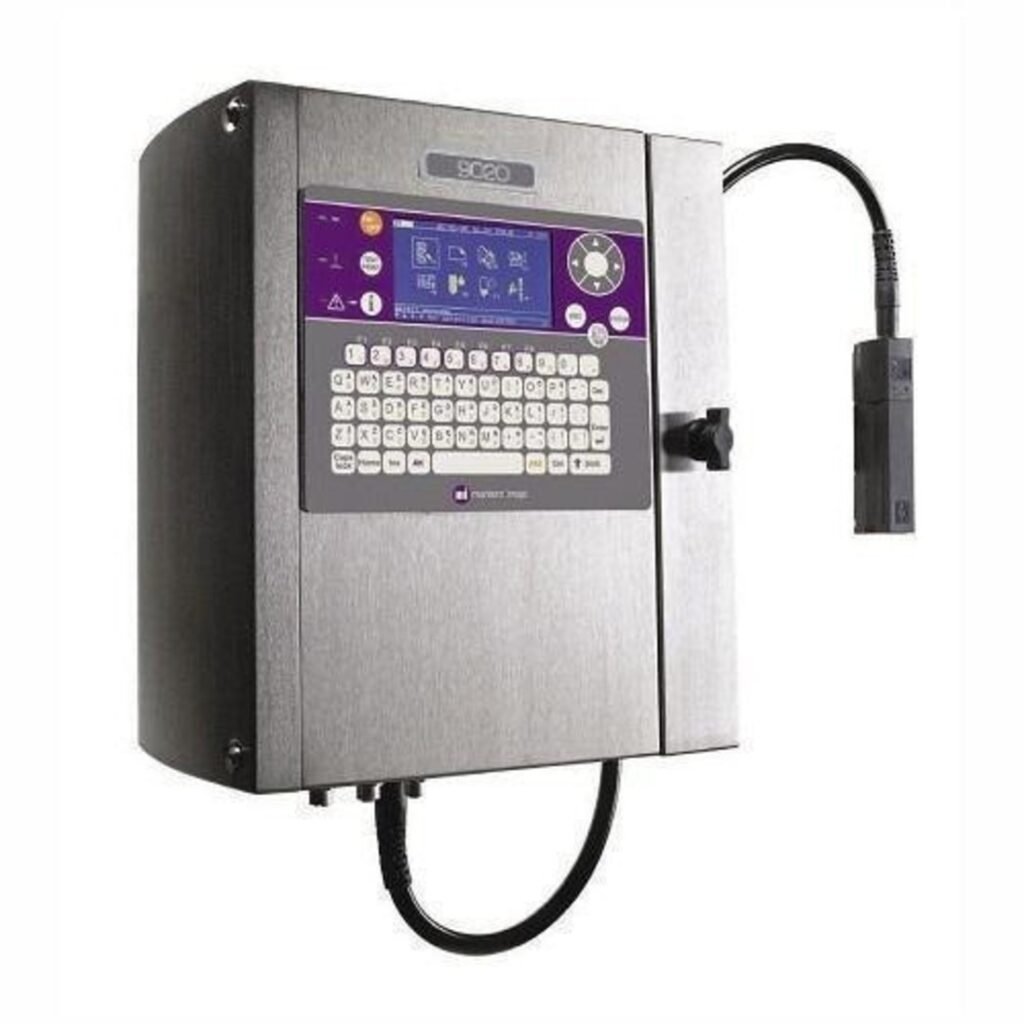
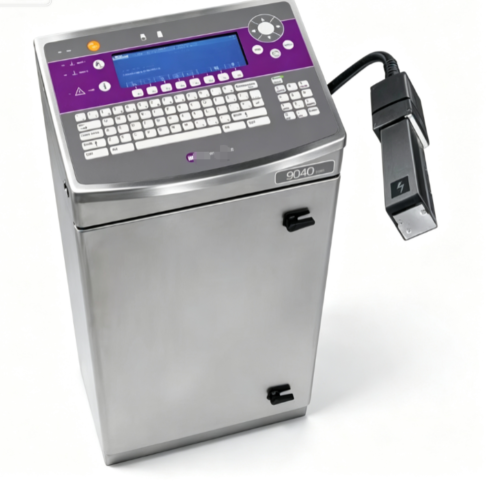
Markem Imaje 9040 (Refurbished)
Key Features:
- Print Capabilities: Single or dual heads (Mono-jet/Bi-jet); up to 8 lines of print; print speeds up to 5.5 m/s; resolutions from 71 to 178 dpi; character heights from 0.7 mm to 18.2 mm.
- Physical & Environmental Specs: Stainless steel cabinet with IP54 rating (IP65 optional); approximate weight of 40 kg (88 lbs); 3-meter umbilical cable; backlit display screen; operating temperature range of 0 °C to 50 °C (32 °F to 122 °F).
- Ink System: 2 pressurized 1-liter tanks (one for ink, one for additive); supports fast-drying, alcohol-based, and pigmented inks; features hot-swap capability.
- Operation & Memory: Stores up to 2,000 messages; supports 29 languages.
- Connectivity & Interfaces: USB, Ethernet, RS-232/422 serial connections, Compact Flash, and SD card options.
- Power Requirements: Auto-switching 100–240 V AC power (200 VA maximum); no plant air required for standard IP54 configuration (required for IP65).
Markem Imaje 904 Printer: A Comprehensive Overview
The Markem Imaje 904 represents a high-performance continuous inkjet (CIJ) system designed for industrial environments requiring reliable marking, coding, and engraving capabilities. This blog explores its core features, technical specifications, typical applications, and practical considerations for organizations seeking durable, fast, and scalable printing solutions.
Key Features and Capabilities
- Single- and dual-head configurations offer flexible printing options, including mono-jet and bi-jet printing to accommodate diverse production lines.
- High-speed performance supports rapid marking with consistent quality, enabling efficient throughput in demanding manufacturing settings.
- Residual-ink management and fast-drying ink options reduce downtime and improve legibility on a variety of substrates.
- Advanced message storage and multilingual support facilitate complex coding sequences across multiple production lines and sites.
- Connectivity options include standard interfaces such as Ethernet and RS-232/422, enabling seamless integration with existing factory networks and equipment.
- Robust enclosure design and environmental tolerance support operation in typical industrial conditions.
Technical Specifications (Overview)
- Print heads: configurable for single or dual-head operation, enabling multiple lines or larger print areas.
- Resolutions and print heights: designed to accommodate a range of text, lot codes, and barcodes with clear readability.
- Ink system: compatible with fast-drying, alcohol-based, or pigmented inks, with capabilities for hot-swapping to minimize downtime.
- Power and environment: designed for 100–240 V operation with a compact footprint suitable for production floors; operates within typical industrial temperature ranges.
- Memory and language support: capable of storing a substantial library of messages and supports multiple languages to address global marking requirements.
- Interfaces: USB, Ethernet, and legacy serial connections support integration with enterprise systems and line controllers.
Typical Applications
- Food and beverage packaging: date codes, lot numbers, and batch tracing.
- Pharmaceuticals and cosmetics: lot fidelity, expiration dating, and traceability marks.
- Automotive and electronics: part identification, production tracking, and compliance labeling.
- Consumer goods and packaging: promotional codes, manufacturing dates, and serial inscription.
Benefits for Production Environments
- Improved traceability: precise, durable markings aid in compliance and recall readiness.
- Reduced downtime: fast ink changeovers and efficient maintenance routines minimize production interruptions.
- Enhanced throughput: high-speed printing capabilities align with demanding line speeds.
- Flexible integration: broad connectivity supports scalable deployment across multiple lines and facilities.
- Operational resilience: robust hardware design and straightforward diagnostics help sustain long-term reliability.
Maintenance and Operational Considerations
- Regular ink cartridge management and timely replacements ensure optimal print quality and system reliability.
- Periodic calibration and head cleaning routines maintain legibility across substrates and environmental conditions.
- Software and firmware updates should be implemented following manufacturer guidelines to preserve feature sets and security.
- On-site support and training for operators can reduce setup times and improve overall yield.
Choosing the Right Configuration
- Assess production line speed and required print area to determine whether a single-head or dual-head configuration best fits the footprint and throughput.
- Consider substrate types (porous vs. non-porous) and ink chemistry to select compatible inks that meet drying times and readability criteria.
- Evaluate existing control systems and network architecture to plan integration paths and data exchange with MES, ERP, or line controllers.
Conclusion
The Markem Imaje 904 stands out as a versatile CIJ solution for industries demanding reliable, high-quality serialisation and marking. Its configurable print heads, adaptable ink options, and robust connectivity enable organizations to tailor the system to varied production environments while maintaining strong performance, readability, and traceability. When considering an upgrade or deployment, a detailed assessment of line speed, substrate compatibility, and integration requirements will guide the optimal configuration and ensure a durable and future-ready marking solution.